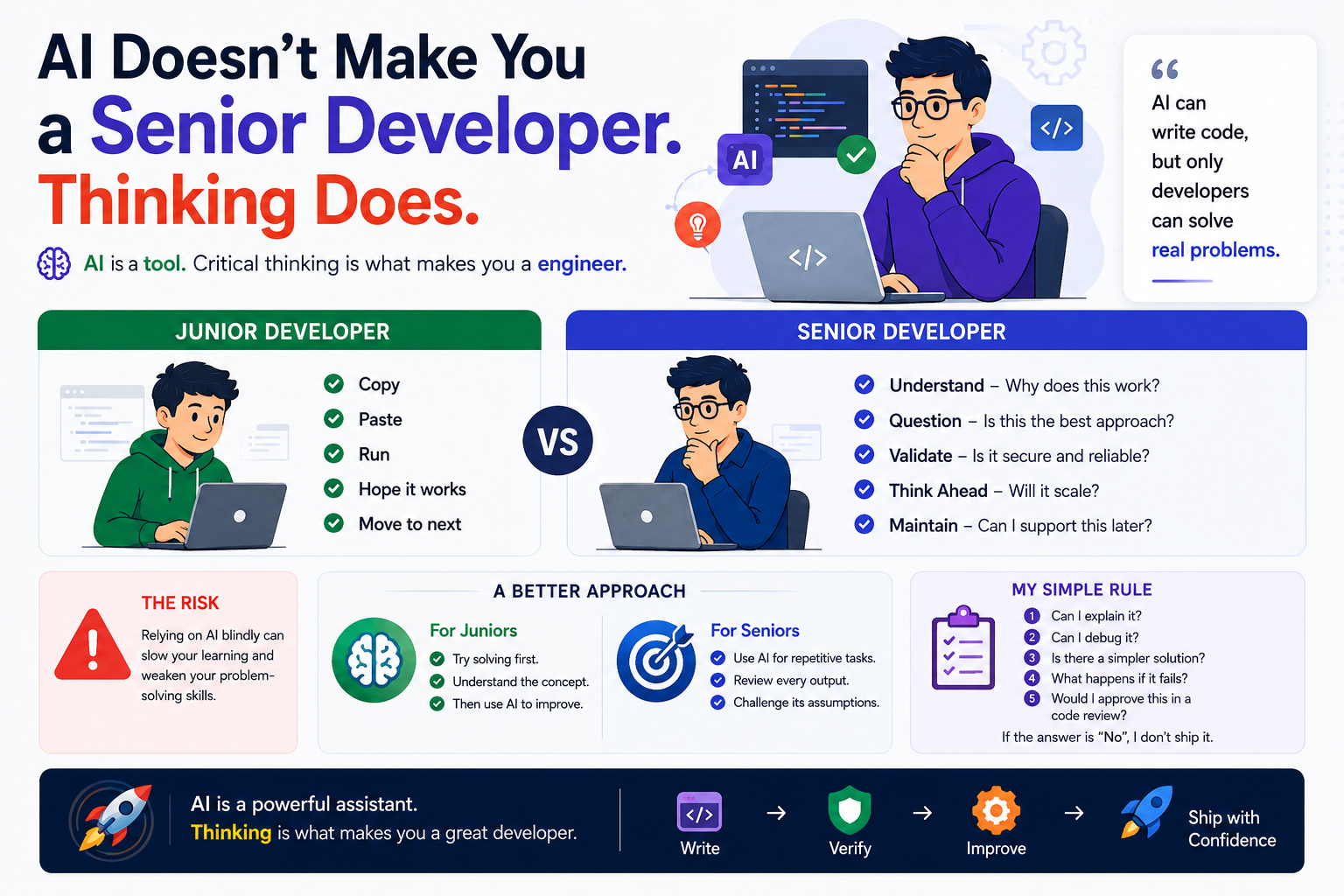
AI has transformed software development. It can generate code, explain concepts, fix bugs, and speed up development—but it doesn’t replace engineering judgment.
The difference between a junior and senior developer isn’t AI usage. It’s how they use it.
Junior vs Senior Mindset
| Junior Developer | Senior Developer |
|---|---|
| Copy → Paste → Run | Understand → Review → Improve |
| Accepts AI output | Questions AI output |
| Focuses on getting it working | Focuses on scalability, security, and maintainability |
Before using AI-generated code, senior developers ask:
- Why does this work?
- Will it scale?
- Is it secure?
- Can I maintain it later?
The Biggest Risk
For junior developers, relying on AI too early can slow learning. Without understanding the basics, debugging and problem-solving become difficult.
For senior developers, blindly trusting AI can reduce architectural thinking and problem-solving sharpness over time.
A Better Way to Use AI
If you’re a junior developer:
- Try solving the problem yourself first.
- Understand the concept.
- Then use AI to improve your solution.
If you’re a senior developer:
- Use AI for repetitive tasks.
- Review every output.
- Challenge its assumptions before shipping.
My Simple Rule
Before accepting AI-generated code, I ask:
- Can I explain it?
- Can I debug it?
- Is there a simpler solution?
- What happens if it fails?
- Would I approve this in a code review?
If the answer to any of these is No, I don’t ship it.
Final Thoughts
AI is one of the best productivity tools developers have ever had—but it’s still just a tool.
AI writes code. Developers solve problems.
The goal isn’t to use less AI.
The goal is to think more while using AI.